The Open Fence Project

Need and opportunity
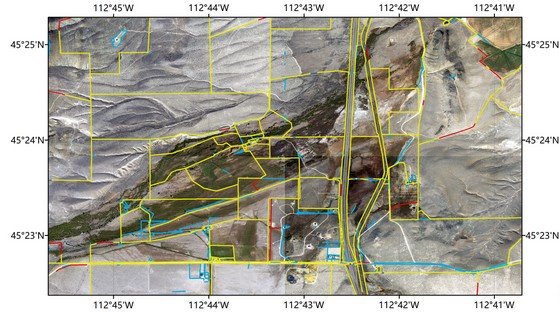
Drive down any road in the western US, and you’re almost guaranteed to see a fence. Fences are one of the most extensive forms of linear infrastructure on the planet, surpassing the length of roads by an order of magnitude. But unlike roads, most fences have never been mapped. Nobody knows how many fences actually exist or where most of them are located.
The advent of artificial intelligence presents a transformative opportunity to address the challenges posed by the lack of comprehensive fence data. We can now systematically and accurately map fences across vast landscapes using AI's capacity to analyze high-resolution remote sensing imagery at unprecedented scales. This technological advancement not only accelerates fence data collection but also offers a replicable and scalable method for generating high-quality fence location data.

Where we are
We recently completed the first large-scale, AI-driven predictive fence map, which covers the rangelands of all 11 states in the continental western United States including the Greater Yellowstone Ecosystem. A manuscript and associated data product have been submitted to a scientific journal for review. Following peer review, our fence database will be made publicly available to scientists, practitioners, policymakers, and the public through an interactive online platform. Concurrently, we will continue to refine AI models and expand the geographic scope of fence predictions.
Our long-term vision is to provide an AI-driven map of fences across the world.
Who we are
Our interdisciplinary, international team includes ecologists, conservation practitioners, and computer scientists.
Ecology and conservation science team

Wenjing Xu (Project lead; Assistant Professor, University of Massachusetts Amherst)
Dr. Xu is a wildlife ecologist and conservation scientist, focusing on animal movement in open landscapes across the western US, east Africa, and the Asia highlands. She is the leading author and coauthor of multiple seminal papers in Fence Ecology.

Kristin Barker (Research Director, Beyond Yellowstone Living Lab)
Dr. Barker is a spatial and behavioral ecologist who directs the Beyond Yellowstone Living Lab. Her work explores how human influences affect large terrestrial mammals. She leads an on-the-ground regional fence mapping effort and serves on the Technical Committee of a working group called the Absaroka Fence Initiative that modifies and removes fences to improve habitat connectivity for wildlife. Kristin focuses on connecting the Open Fence Project to real-world applications.
Artificial Intelligence team

Weijia Li (Associate professor, Tsinghua Shenzhen International Graduate School, Tsinghua University)
Dr. Li specializes in the interdisciplinary field of remote sensing and computer science with a focus on the intelligent processing of high-resolution remote sensing imagery and environmental perception.

Zhongqi Miao (Research scientist, Microsoft AI for Good lab)
Dr. Miao specializes in integrating AI with environmental science and biodiversity conservation. He is also enthusiastic about addressing complex real-world challenges like long-tail distribution and large-scale multi-modal models.

Zhenghao Hu (Graduate student)
Supervised by Dr. Li, Zhenghao is interested in environmental monitoring by applying AI to interpret high-resolution remote sensing images.
Zhutao Lv (Undergraduate student)
Zhutao Lv is a rising master's student in remote sensing, advised by Professor Li. He is interested in applying AI to environmental analysis.
Advisory board

Thomas Müller (Director, SBIK-F)
As the head of the research group ‘Movement Ecology’, Dr. Müller’s research focuses on the theoretical and applied aspects of movement and wildlife ecology.

Arthur Middleton (Associate professor, UC Berkeley; Co-director, Stone Center for Environmental Stewardship)
Dr. Middleton's research focuses on the ecology and conservation of migratory large mammals, with a strong emphasis on informing policy and management.

Jerod Merkle (Associate professor, University of Wyoming)
Dr. Merkle is the Knobloch professor in migration ecology and conservation, emphasizing research co-production with partners for managing and conserving wildlife habitat.

Dr. Rahul Dodhia (Deputy director, Microsoft AI for Good lab)
Dr. Dodhia manages a team of research scientists in their efforts to address global challenges using data science and artificial intelligence, particularly in sustainability.